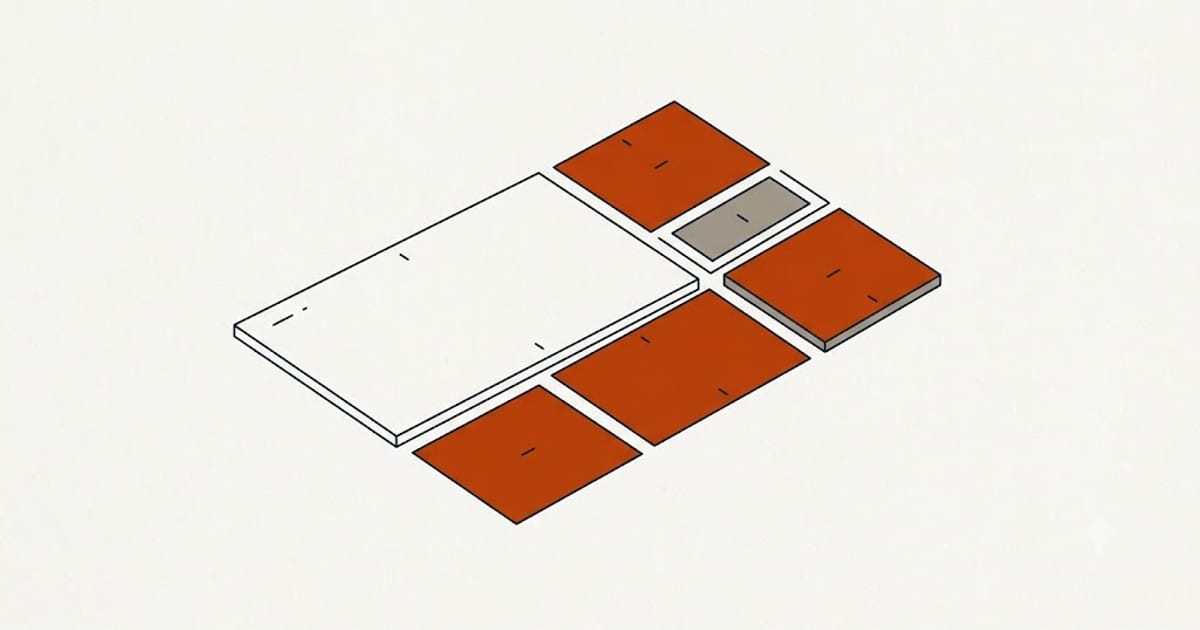
Ductless heat pumps are now used as the primary heating system in cold climates, and the design question is how many heads and where.
The two failure modes
Too many heads — one per room — is expensive, gives each head a very small load it struggles to modulate down to, and clutters every wall.
Too few heads leaves rooms that are only heated when their doors are open, which in practice means bedrooms are cold at night, which is when the doors are closed.
Between those is the actual design.
The rule that decides it
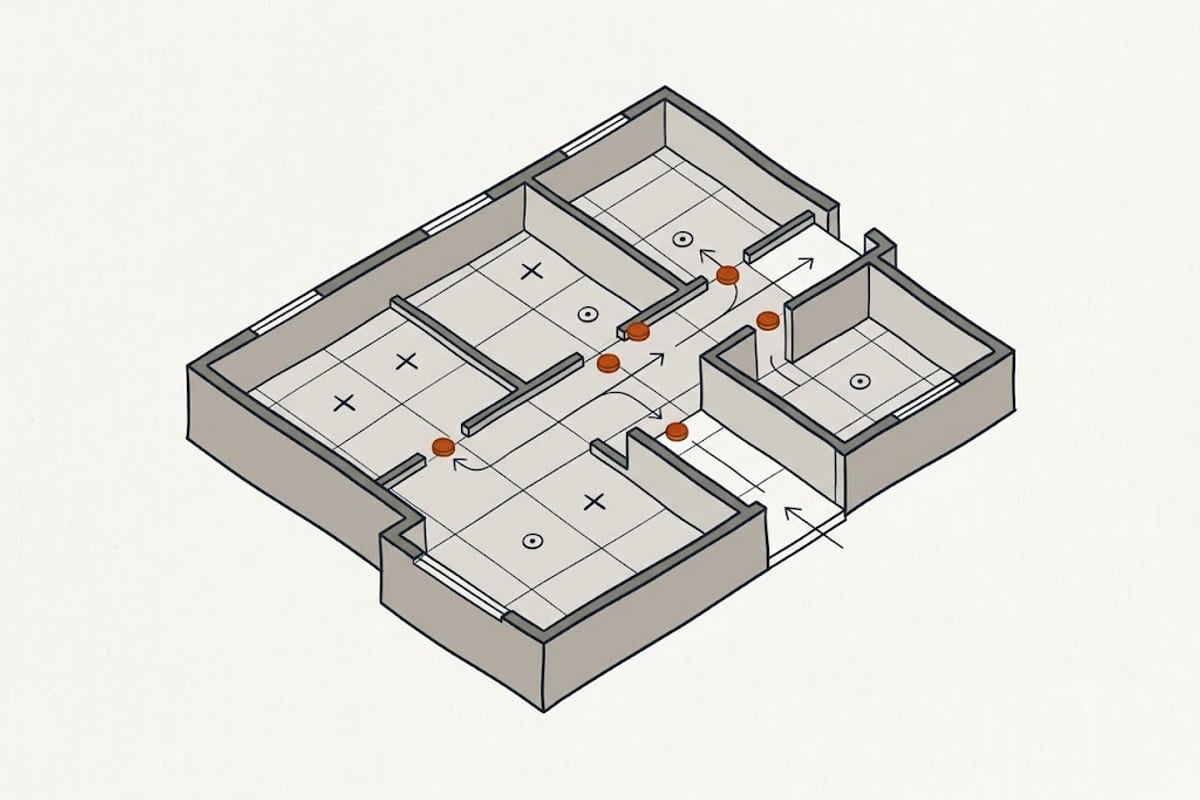
A head serves the space it can reach with air. A closed door stops it.
So the question for each room is: will its door be closed while it needs to be warm?
Living spaces, kitchens, open plan areas — usually open, and one or two heads serve them well.
Bedrooms — closed at night, which is exactly when heating matters. A bedroom without a head, relying on a hallway head with the door ajar, is the most common source of complaint.
Bathrooms — closed and small, and a head is oversized for them. Electric resistance heat, a heated floor or a fan heater is usually the sensible answer.
The compromise that usually works
Heads in the main living space, one per bedroom, and resistance heat in the bathrooms and any small enclosed space.
Where budget is limited, some households accept cooler bedrooms and use a small electric heater in each. That works and it moves the coldest hours onto the most expensive fuel, which is worth understanding rather than discovering.
Bedroom heads are small
A bedroom load is often 4,000–6,000 BTU/h, and the smallest available head is commonly 6,000 or 9,000 BTU.
That means bedroom heads are frequently oversized by necessity, with the cycling and humidity consequences. Choosing the smallest head available, and a system with a wide turndown range, is the mitigation.
It is also an argument for a ducted mini-split serving several bedrooms through short concealed runs, which gives one correctly sized unit instead of three oversized ones.
Backup heat
Even cold-climate equipment reaches a balance point below which it cannot meet the load.
For a whole-house ductless installation the options are: retain the existing furnace as a backup, install electric resistance heat in the coldest rooms, or accept that on a handful of extreme days the house runs a degree or two cool.
All three are defensible. Choosing deliberately, with the manufacturer's extended capacity table and the local design temperature side by side, is what separates a designed system from a hopeful one.
The envelope matters more here
A ductless system delivers heat to specific points, so a house that loses heat unevenly will feel uneven.
Air sealing and attic insulation are worth more in a ductless house than in a ducted one, because there is no central system continually mixing the air between rooms.
What it gives up
Whole-house filtration, since each head has a small washable filter.
Ventilation, which needs its own provision — an ERV or HRV with its own small duct system, or through-wall units.
Humidity control in winter, since there is no central point to add a humidifier.
None of these is a reason not to do it, and each of them is something a ducted system provides incidentally and a ductless house has to arrange on purpose.
Electrical capacity
A whole-house ductless installation replacing a gas furnace moves the entire heating load onto the electrical service.
Each outdoor unit needs its own circuit, and any electric resistance backup adds substantially more. On an older panel this can require a service upgrade, which is a significant cost that belongs in the comparison from the start rather than appearing as a change order.
An electrical load calculation is the equivalent, on this side, of the Manual J on the heating side, and it is worth having done before the equipment is ordered.