
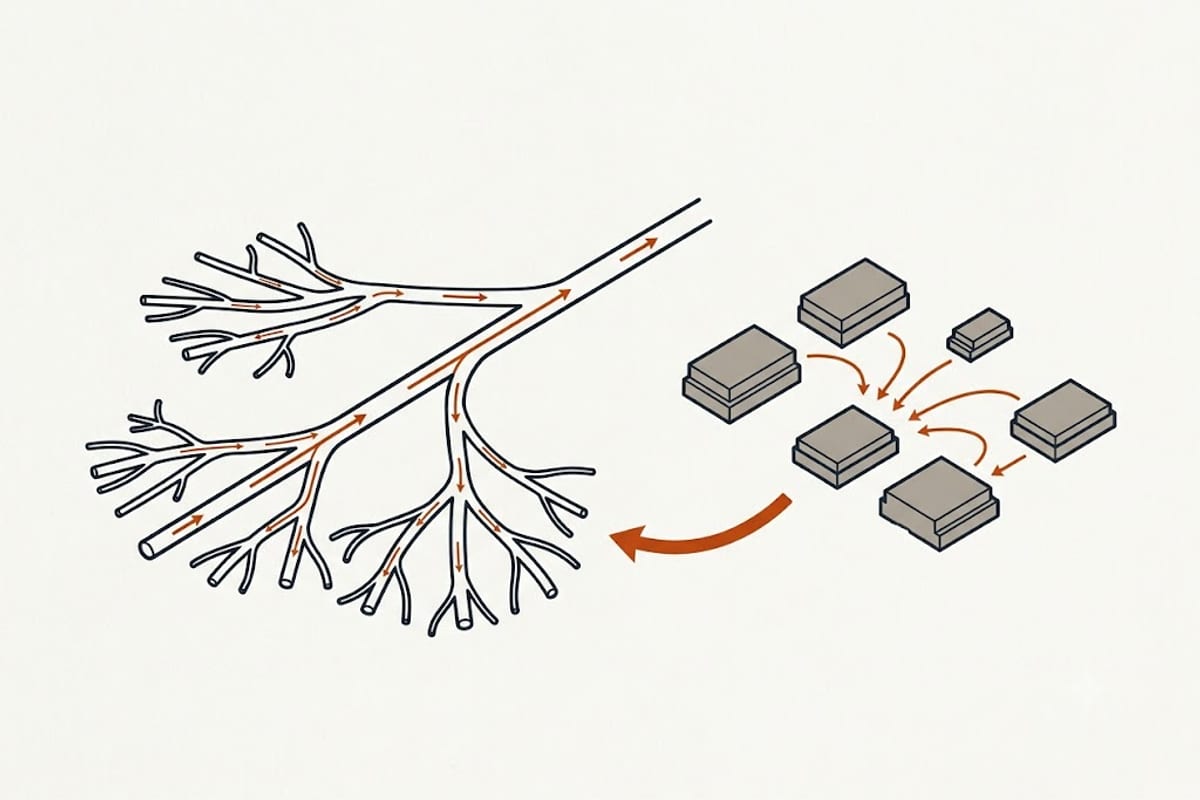
The two arrangements solve the same problem differently, and which is better depends far more on the house than on the equipment.
Where ductless wins
No ductwork exists. In a house with hydronic or electric baseboard heat and no ducts, retrofitting a duct system is a major and intrusive project. Ductless avoids it entirely.
Duct losses would be large. Ducts in an unconditioned attic commonly lose 20–30% of the system's output. A ductless system has none of that loss, which is a substantial real-world efficiency advantage that ratings alone understate.
Rooms are used very differently. A home office conditioned all day and bedrooms only at night is exactly what per-room control is for.
An addition or a converted space that the existing system cannot serve.
A room that is always the wrong temperature — over a garage, a sunroom, a finished attic.
Zoning is wanted without the complexity and the bypass problems of a zoned ducted system.
Where central wins
Ductwork already exists and is in reasonable condition. Reusing it is far cheaper than a whole-house ductless installation.
Whole-house filtration. A central return passes all the air through one filter, which can be a deep media or an electronic filter. Ductless heads have small washable filters that do very little.
Whole-house humidity control, since a central system can incorporate a dehumidifier or a humidifier serving the whole house.
Ventilation. An ERV or HRV integrates naturally with a ducted system and needs its own distribution otherwise.
Appearance. Registers in a ceiling are less visible than a head on a wall, and this matters to many people more than they expect it to.
Even temperatures in an open plan, where central supply air mixes better than a single head's throw.
Cost
For a house with usable ducts, replacing central equipment is generally cheaper than a whole-house ductless installation with five or six heads.
For a house with no ducts, ductless is dramatically cheaper than installing them.
That is most of the decision, and it is a property of the house rather than a merit of either technology.
The hybrid that is frequently the right answer
Keep the central system for the main body of the house and add one or two ductless heads for the specific rooms it cannot serve.
This is cheaper than either extreme, it targets the actual complaint, and it is the arrangement most often reached by people who started out asking which of the two to choose.
Ducted mini-splits
A third option that gets little attention: a compact ducted air handler driven by an inverter outdoor unit, serving two or three rooms through short duct runs inside the envelope.
It gives the inverter modulation and efficiency of ductless equipment with concealed distribution and a proper filter, and it suits a floor or a wing rather than a single room.
What decides it in practice
Whether ducts exist and where they run. Whether the rooms are used on different schedules. Whether anyone in the house cares strongly about wall-mounted units.
Efficiency ratings are the least useful input, because the distribution losses — which the ratings do not measure — are larger than the difference between the ratings.
Noise
A ductless head sits in the room it conditions, so its fan is audible in that room — quiet, but present, and noticeable in a bedroom at night.
A central system's blower is in a basement, attic or closet, and what reaches the room is air noise at the register.
Head fan noise is published as a sound rating at each speed, and the lowest setting on modern equipment is very quiet. It is still worth listening to one before putting one in a bedroom, because it is the objection people raise after installation rather than before.
Resale
Opinions differ and the pattern is reasonably consistent: in a house that never had central air, adding ductless is clearly a gain. In a house with existing ducts, replacing central air with wall-mounted heads is a mixed signal to a buyer.
That is worth weighing where the decision is close, since the appearance objection is the one a future buyer will also have.